Prefer video? If you don’t want to read, hit the video above—this article follows along.
Quick disclaimer: I own Steel Health & Hormones Centre, a TRT-focused clinic serving the Westmoreland and Allegheny County Pennsylvania, but I am not a medical professional. This content is for education and entertainment only and is not medical advice. Please work with a qualified clinician for diagnosis and treatment.
Why test type matters
We routinely meet men who feel classic low-T symptoms—low energy, low mood, lower libido, losing muscle—yet were told, “you’re fine for your age.” Sometimes they’re even steered toward an SSRI. Then they show us labs with a total T in the 500s, and it looks “normal” at first glance. But how that number was measured can change the story.
The two common methods (plain English)
1) Immunoassay (fast and common)
Most primary-care offices and big labs use an immunoassay method. It’s fast, affordable, and widely available—but with steroids like testosterone (small molecules that look a lot like other hormones), immunoassays can be less specific. That means certain other steroids can “look” like testosterone to the test (cross-reactivity), nudging results up or down—especially at lower concentrations or in women/younger patients.
How competitive immunoassay works (quickly):
Your testosterone and a fixed amount of labeled (tracer) testosterone compete for a limited number of antibody binding sites.
- More of your T present → less tracer binds → lower instrument signal → analyzer reports a higher T (it’s an inverse curve).
- Less of your T → more tracer binds → higher signal → reported T is lower.
A helpful analogy:
Think of a stadium with limited seats (antibody sites). White jerseys are your real testosterone; purple jerseys are the labeled tracer. The machine counts how many purple jerseys got seats. If few purple jerseys sit, we infer lots of white jerseys (high T). If many purple jerseys sit, we infer low T.
Now add grey jerseys—other steroids that resemble T (e.g., DHT, androstenedione). They can also take seats, pushing out purple, which can make it look like there are more white jerseys than there really are (a falsely high T). That’s cross-reactivity.
Practical note: Some immunoassays also have upper reporting limits (e.g., around 1500–2000 ng/dL depending on the analyzer). Very high samples may require dilution to report accurately.
2) LC–MS/MS (more specific)
Liquid chromatography–tandem mass spectrometry (LC–MS/MS) separates testosterone from look-alikes first, then measures it by mass. Translation: it’s far more specific, greatly reducing cross-reactivity. That’s why LC–MS/MS is often recommended for lower concentrations, women/children, or whenever precision really matters. Many specialty clinics (including us) prefer LC–MS/MS for decision-making.
A real-world example (my own labs)
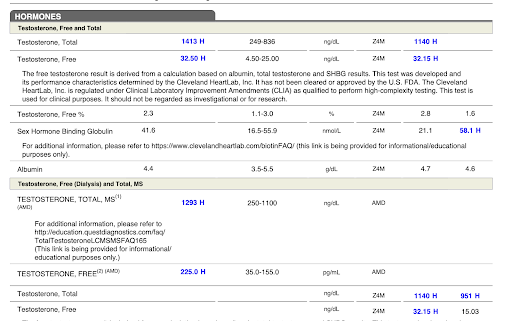
I ran both tests at the exact same time so you can see how results can differ. In my case, the immunoassay read about ~10% higher than LC–MS/MS. Differences can vary by person and context (lab method, concentration, cross-reactants, etc.), and double-digit gaps do happen in the real world.
Side note: I purposely tried to “stress test” the immunoassay by taking a full week’s dose in one injection to see if I could push the immunoassay past its top range. (Not something I recommend—always follow medical guidance.) Even so, I didn’t hit the analyzer’s upper limit that day. Your mileage may vary, and different labs use different instruments.
The takeaway
- Immunoassay: convenient and common, but can be less specific for steroids.
- LC–MS/MS: typically more accurate/specific, especially when precision matters.
- If your symptoms and your numbers don’t match, consider how the number was measured—and talk with a clinician about whether LC–MS/MS would be the better read for you.
Want help sorting it out?
If you want to understand your testosterone levels with greater confidence, fill out the contact form below. Steel Health & Hormones Centre (Greater Pittsburgh) will connect you with a licensed provider, and we’ll follow up within 24 hours.